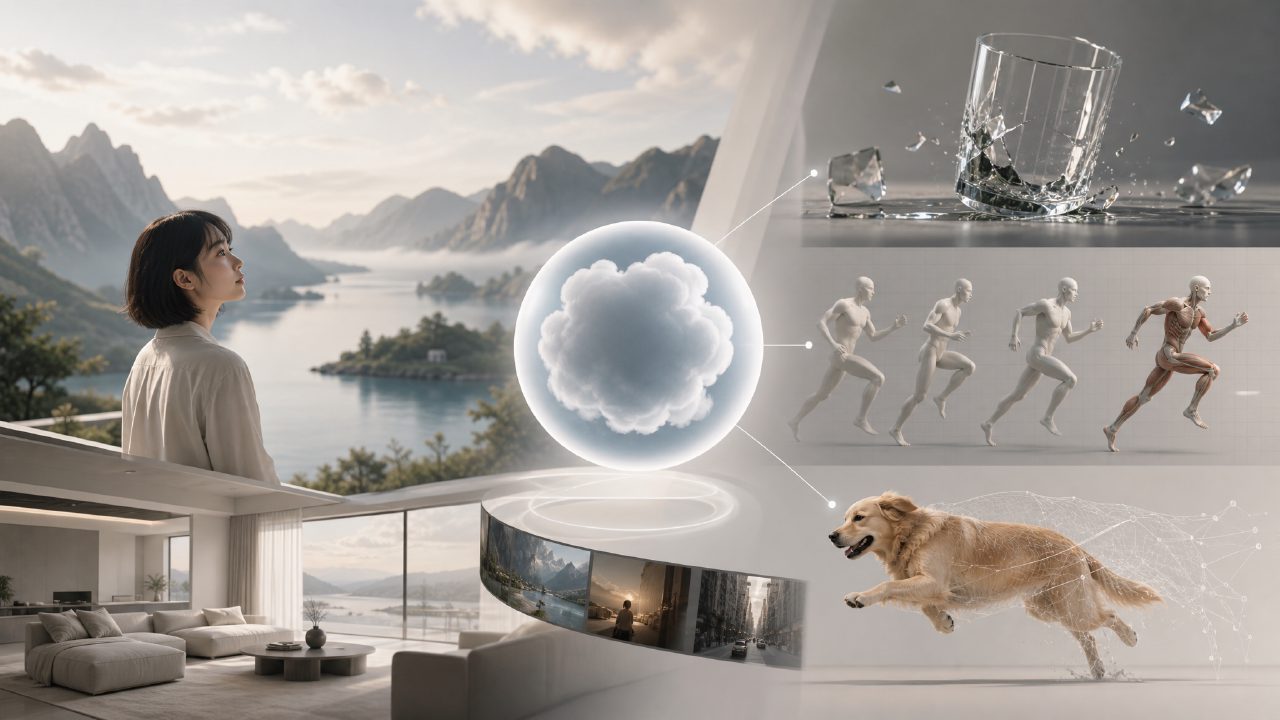
The day I got access to OpenAI Sora, I wasn't particularly excited, to be honest. By then, I had already been bombarded for months with leaked videos and secondhand reviews, so I had a preconceived image in my mind. Once I actually started using it, my feelings in the first half hour were somewhat conflicted—it indeed achieved the act of generating video from text, but the gap between 'getting it done' and 'doing it well' was bigger than I expected.
First Round of Impact: Permission Isn't the Barrier—Understanding What It Can Do Is
Sora's interface is simpler than I imagined—basically just an input box and a button. You write a prompt, and it generates a video. But this minimalism also brings a problem: it's hard to predict how it will interpret your description. For example, I tried 'a narrow alley in Tokyo at dusk, a girl in a red kimono looks back at the camera, paper lanterns gently swaying.' The composition of the resulting footage was stunning, and the lighting was as soft as a real shot. But the girl's turning motion was too slow—so slow that you could feel the stutter between each frame. This isn't a frame rate issue; it's that the model's temporal understanding of the action 'turning head' lacks the fluidity that human intuition expects.
Another surprising point: Sora has a clear preference for physical logic. When I asked it to generate 'water spilling from a cup,' it did it extremely realistically—surface tension, light refraction all looked genuine. But when I asked for 'a cat pushing a cup off the table,' the cat's paws often clipped through the tabletop. In other words, Sora excels at visually high-frequency scenes like fluids and lighting, but when it comes to object interaction and biological motion, there's still an obvious machine-like quality. This isn't something that more clever prompting can fix—it's a fundamental gap in the model's learned understanding of the physical world.
Several Real-World Scenarios in Use
I tested three different use cases to gauge its boundaries:
The first was 'product display.' I gave a close-up description of a thermos, requesting the camera slowly zoom in, with condensation droplets on the surface. Sora rendered the material texture quite well—the brushed metal lines were clear—but during the zoom, the cup's edges experienced unnatural distortion a few times, as if the cup itself was breathing. This kind of flaw is subtle in short clips, but if you were to cut it into a formal video, it would be an instant giveaway.
The second was 'dynamic scene recreation.' I wrote 'in a rainstorm, a person holding a black umbrella crosses an intersection, with cars splashing water around.' The rain streaks and reflections in this scene were stunning, essentially matching the quality of real footage. But the pedestrian's umbrella suddenly turned greenish in the second half, as if the white balance drifted. It wasn't a stylistic color shift—the model simply failed to maintain color consistency.
The third was 'facial micro-expressions.' This was probably the most frustrating part. Sora-generated faces are very appealing when still—skin texture even surpasses some phone filters. But once the face starts smiling or blinking, there's a brief but distinct 'morphing transition'—eyes shrink, mouth corners deform, then snap back. You could cut it out, but this unpredictability makes 'character close-ups' quite risky.
Is It Worth the Effort to Get Access?
If you're aiming for 'one-click finished footage,' Sora isn't there yet. Its output is more like a high-cost, high-variance concept material library—some results are truly great, others are truly broken. You have to be mentally prepared to keep rolling the dice, and the same prompt can yield wildly different results on two attempts.
My advice: treat Sora as an 'inspiration amplifier' or a 'tool for exploring specific shots.' For example, if you want to shoot an underwater light show but can't do it for real, run a few rounds in Sora to find the ideal color combination and composition, then use those screenshots or short clips as reference boards for post-production or actual shooting. If you try to use it to directly generate finished clips for a project, the risk is still relatively high—unless your project has very low requirements for visual consistency.
Also worth mentioning: there's been a lot of discussion among users about Sora's token billing model details, but based on my own experience, the number and length of videos you can generate per day are limited. For serious creative work, the cost is higher than expected. The most comfortable use case is actually 'using it to test ideas'—while writing copy, you casually write a few prompts, run a 5-second animation, and see if the visual direction feels right. This process is genuinely smooth and intuitive.
Ultimately, getting OpenAI Sora access is like being able to touch the glass wall of the future a little early. The world on the other side is beautiful, but you still can't fully walk over to it. Treat it as a particularly good draft tool, not as a final delivery tool, and you'll approach it with a much calmer mindset.
Comments
Leave a Comment