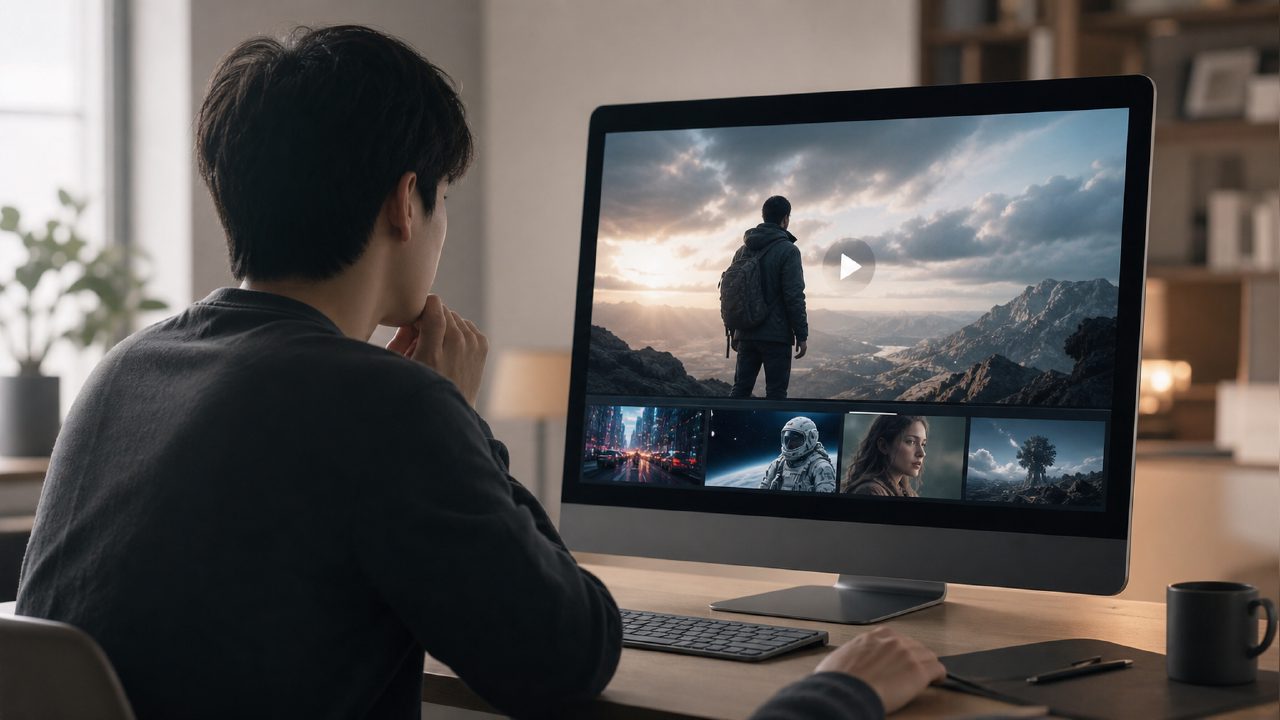
After waiting for several months, I finally got the testing qualification for OpenAI Sora access. Honestly, the application process was more troublesome than expected, but the first thing I did after getting it was to run a few of my video projects through it. This post isn't about praise or criticism — just some genuine feelings and judgments after hands-on use.
From "dare to use" to "can use" — Sora bridges the gap
Anyone in video production knows there's been no shortage of AI video generation tools in recent years. But most tools produce results that scream "AI" — stiff movements, broken logic, flickering lighting. Sora's biggest difference is that its generated frames, at least in static shots, show no obvious flaws.
The first prompt I tried was "a girl holding a transparent umbrella walking under neon lights in Tokyo on a rainy night" — a cliché scene. But in Sora's output, the splatter direction of raindrops hitting the umbrella, the distorted reflections of neon lights on the wet ground — all correct. It's not just about being "correct"; it's about being "plausible."
What really changed my mind was coherence
With other AI video tools, the biggest fear with long shots was the face changing after a character turns around. Sora handles this quite stably. I specifically tested a 15-second continuous shot: a person gets up from the bar, walks through the crowd, pushes the door open, and goes outside. When the light switches from indoor to outdoor, the continuity of clothing wrinkles and hair strands held up well.
Of course, it's not perfect. In one frame, the character's right hand briefly blurred, as if it "forgot" to draw the fingers. Such minor issues aren't rare in Sora's outputs, but they're no longer the kind of frustrating "facial feature misplacement" level.
A few truly useful scenarios
After testing about 20 prompts, I found Sora excels in these categories:
Product demo scenes. For example, "a ceramic coffee cup slowly rotating on a wooden table with natural surface texture." Tasks that don't require complex narratives and just need visual quality — Sora's output rate is very high, almost no need for secondary edits.
Environmental atmosphere clips. "Aerial view through a pine forest in morning fog" — lighting, fog movement, layering of branches — cleaner than many stock footage shots. Plus, no copyright issues, very practical for title sequences and transitions.
Abstract concept visualization. I discovered this myself. If you input an abstract description like "data flowing like a blue river through city buildings," Sora gives you a visually striking clip — not necessarily completely faithful to your imagination, but good enough as a reference for inspiration.
What's not publicly available is what deserves serious thought
OpenAI hasn't fully opened all of Sora's capabilities. I noticed several limitations during use:
- Although the maximum video length is marked as 60 seconds, when actually running content over 30 seconds, the error probability increases significantly. The more complex the motion, the more likely logical breaks appear after 20 seconds.
- Facial detail heavily depends on prompt precision. If you just write "an Asian middle-aged man talking," the result will likely have blurry features. You must add descriptors like "clear facial features, even skin tone, natural expression."
- Safety filters are very strict. I tried a mild conflict scene like "two people in raincoats arguing in the rain," and it was directly flagged as a violation. This isn't a technical issue — it's a policy issue.
These limitations mean that at this stage, once you get OpenAI Sora access, it's better suited for auxiliary material generation rather than independently completing a full narrative short. If you expect to input one sentence and get a finished video ready for use, you'll likely be disappointed.
Should you apply for access?
My judgment is twofold.
If you work on brand ads, product showcases, MV atmosphere clips — content that demands high visual quality but doesn't have long narrative chains — Sora can save you a lot of time on set building, location shooting, and post-production rendering. Its ceiling is a notch higher than similar tools on the market.
But if you make narrative short films, daily vlogs, or dialogue scenes requiring precise control over expressions and lines, the current Sora isn't mature enough. It's fine as a toy or inspiration aid, but far too early as a primary filming tool.
Also, the time cost of circumventing firewalls, applying, and waiting for approval is real. Not everyone should go through the trouble.
One last thing: Sora is currently the most worthy tool to study in the AI video generation field — no exceptions. But "worthy of study" and "worthy of use" are two different things. After gaining access, run three unimportant projects through it first, then decide whether to incorporate it into your formal workflow.
Comments
Leave a Comment