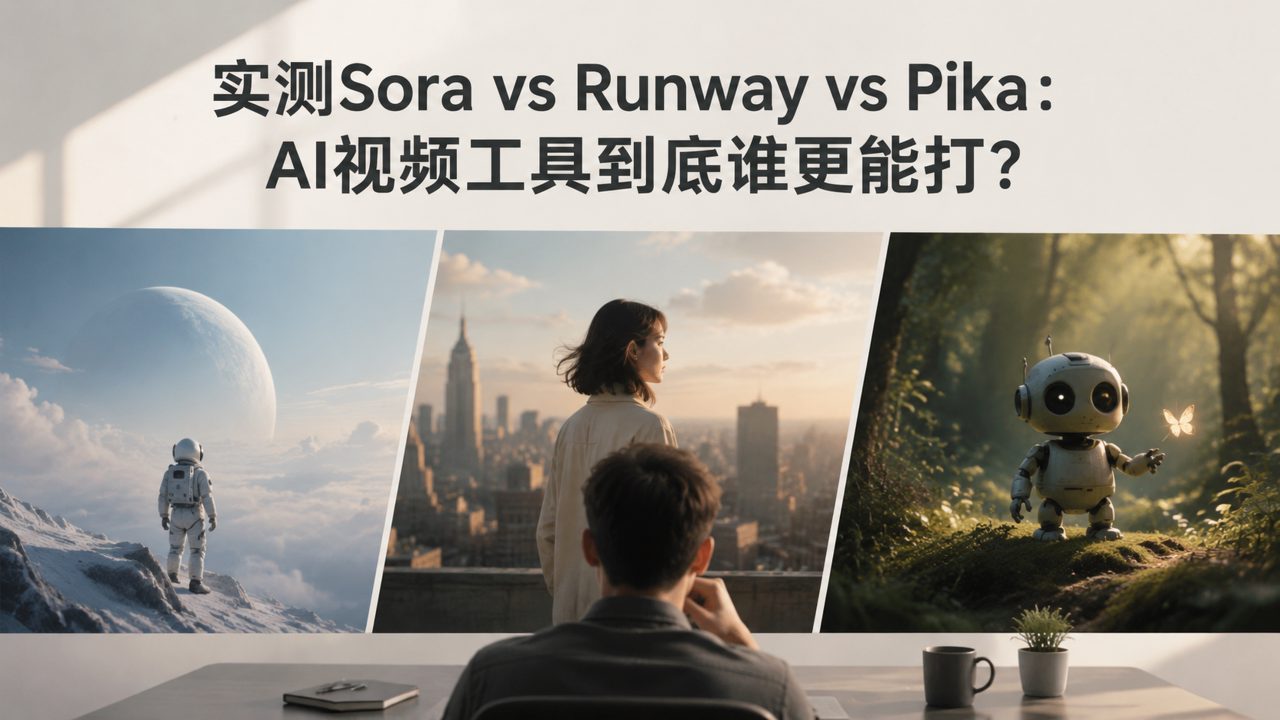
People making AI videos have been buzzing about one name recently: Sora. A two-minute video generated from a single text prompt, with camera movements that carry a narrative feel. But the question follows: can this tool actually be integrated into your workflow? Compared to others, does it really 'perform'? I ran several rounds of tests on getsora2, then tried a few similar platforms. Here are the conclusions directly.
Output Capability: Sora's 'Length' Is Actually a Hurdle
Sora's most impressive feature is the length of a single video. Most AI video tools currently operate within 4 to 8 seconds, while Sora starts with two minutes. Sounds great, but there's a trade-off in practice: each generation takes much longer than others. Imagine you just need a 3-second transition clip, but you have to wait for Sora to run through the whole process — a waste.
In comparison, Runway Gen‑3 offers more stable speed and randomness control for short clips, and Pika is better suited for rapid iteration demos. It's only in scenarios requiring continuous narrative (like brand films, MV narrative segments) that Sora's long clips truly shine.
Controllability and Stylization: Which One Listens Better?
I fed the same prompt — "A cat with a porcelain texture walks along a rainy alley, camera keeping a low-angle follow shot" — to Sora, Pika, and Runway. Sora delivered the highest fidelity: the cat's posture, material reflections, ripples in puddles — mostly matched. But there's one issue: it's not easy to steer when 'setting the tone'. If you want an overly exaggerated style (say, cyberpunk combined with ukiyo-e), it tends to produce a more moderate result.
Pika's strength is its filter overlay capability — if you're not satisfied with one prompt, you can tweak the scene atmosphere on the fly. Runway excels in precise positional control; it understands commands like "enter from the left and stop on the right". Meanwhile, Sora is better at maintaining coherence across a scene — you don't have to piece together segments one by one. This may not matter much for e-commerce main image videos, but if you're working on narrative shorts, the difference is huge.
Scene Adaptation: Where Should Sora Fit in Your Toolchain?
After chatting with a few friends in advertising production, we reached a consensus: Sora is not meant to replace Runway or Pika, but to complement them. For example:
- Short-form viral product videos (Kuaishou style) — Pika (for quickly generating multiple variants) + CapCut (for adding effects and text) is already sufficient; Sora feels too heavy.
- Rough cuts of product concept films — Use Runway to generate key shots, then use Sora to create a 30-second moody opening. This combination outperforms using any single tool.
- Bilibili knowledge-section dynamic presentations — Sora's advantage is entirely wasted; running text-to-speech on Replicate with a bunch of static images is actually faster.
So, if you're managing multiple product lines simultaneously, a tool combination is more efficient than fixating on a single tool.
Practical Balance: Should You Switch from Your Current Tool?
Here's an uncomfortable truth: if you already have a smooth workflow with Runway or Pika, switching directly to Sora may not improve quality and could even slow down delivery. However, if you're creating continuous narrative content — like brand films, short dramas, or even MV trailers — Sora can save a lot of time spent 'stitching fragments together' — that's its most irreplaceable advantage right now.
Weighing it up, I suggest categorizing your needs: for quickly producing single frames or short loop clips, stick with your old methods; for long-shot narratives or consistent atmosphere, start experimenting on getsora2. Walking on two legs is more reliable than blindly trusting one 'all-in-one' tool.
Comments
Leave a Comment