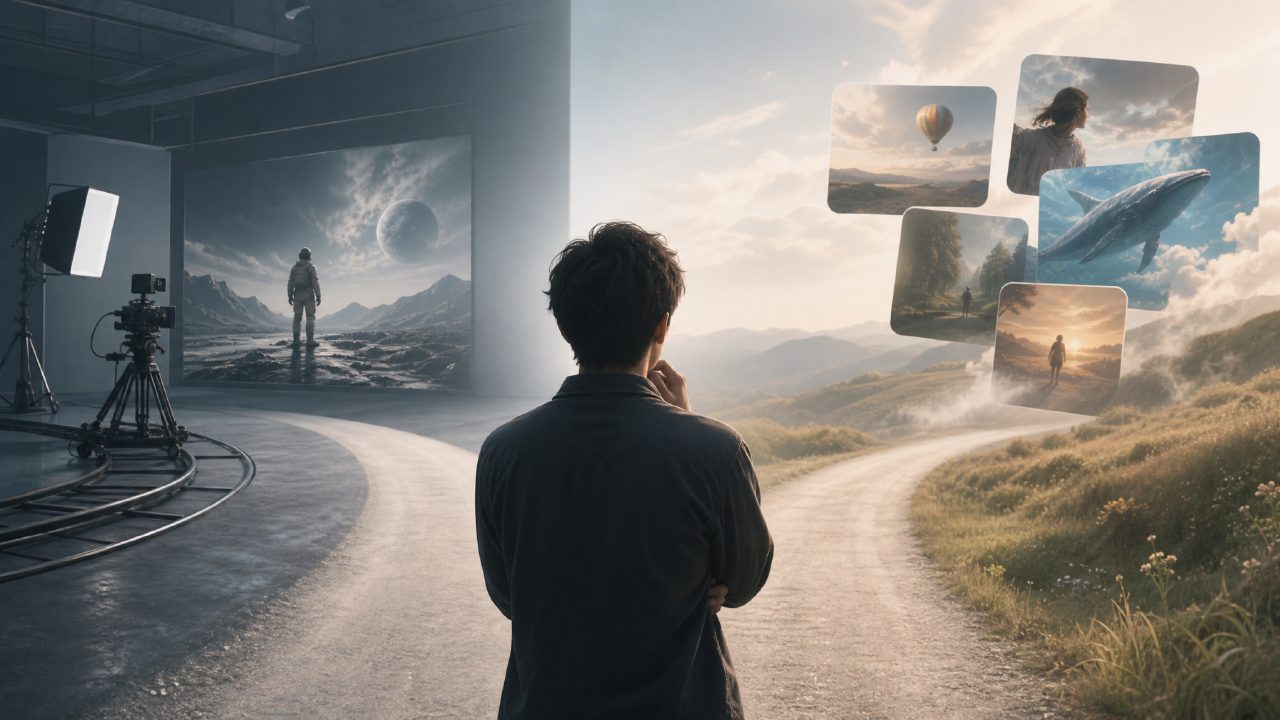
People working on video projects now find it hard to avoid a choice: for the task at hand, should I use Runway or take a gamble on Sora?
This is not a pointless comparison, but a frequent bottleneck in real projects. I once had a client who needed a fast-paced brand promotional video, about 30 seconds long, requiring many dynamic transitions and particle flow effects. My first instinct was to open After Effects and tough it out. But the deadline was only two and a half days, with both rendering and revisions needed—the traditional workflow simply couldn't finish in time. I then tried Runway's Gen-2 and the latest Gen-3 Alpha, and found it could directly generate a rhythmic sequence of shots based on a script, and frame adjustments didn't require re-rendering the entire clip. In the end, the client had no complaints about the delivered video, but I knew if I had used Sora, which was still in beta at the time, just waiting for rounds and adjusting prompts would have been a huge headache.
Runway and Sora are fundamentally two different approaches. Runway is more like a professional video workbench, where generation, editing, and fine-tuning details can all be done within the same interface, with particularly solid controllability. You drop a video in, want to replace an object, extend an action, or change the overall color tone—Runway delivers results in seconds without messing up other parts of the frame. This is crucial for commercial projects that require repeated revisions.
Sora's strength, on the other hand, lies in the "texture" and "imagination" of the generated visuals. Its output shots are truly impressive in terms of lighting realism and scene innovation, especially those complex facial expressions and subtle emotional changes—Sora does them closer to live footage than any current tool. But its shortcomings are also obvious: once you get a satisfactory generation, if you want to tweak a detail, it's basically impossible. It doesn't give you a layer, a mask, or a keyframe. You have to rewrite the prompt and regenerate, and the result might be completely different. This makes fine post-production control impossible.
If you're handling batch content for short-video platforms, such as producing several voice-over or product demonstration videos per day, Runway offers better cost-effectiveness. Its real-time preview and local editing allow you to reuse a single piece of footage repeatedly—changing backgrounds, outfits, or product colors—with almost no extra cost after several rounds of modification. Sora's current model, however, is better suited for concept films, emotional shorts, or artistic expressions that are "one-shot, no revisions." It's not suitable for the back-and-forth of commercial production lines.
The key to choosing actually lies in how much you value "control." If you're working on ads, marketing videos, or e-commerce videos, things can change a lot—clients changing requirements, post-production adding shots, bosses suddenly wanting to swap footage—then don't hesitate, Runway is the more stable choice right now. It not only gives you generative capabilities but also leaves room for later changes. On the other hand, if you're making narrative shorts, visual experiments, or want shots that have a strong "live-action feel" but are impossible to film in reality, then Sora is currently the most efficient path to cinematic quality.
Another practical issue is batch processing and cost. In Runway, projects are billed by the second and by feature, but you can precisely estimate how much a project will cost. Sora, however, still operates on a lottery logic—you don't know which prompt will hit, and even if you get a hit, you can't directly reuse it. If you prioritize controllable budgets and predictable work hours, Runway is far more mature than Sora at this point.
Back to my brand video project. If I had only had Sora at the time, I would likely have been stuck in a dead loop of "generating something that looks good but always has one or two flaws," eventually having to deliver a 70% finished product. Runway gave me the freedom to generate something roughly right and then polish it in the details until it was right. In other words, it puts "creation" and "refinement" into the same workflow, while Sora currently only handles the former.
Comments
Leave a Comment